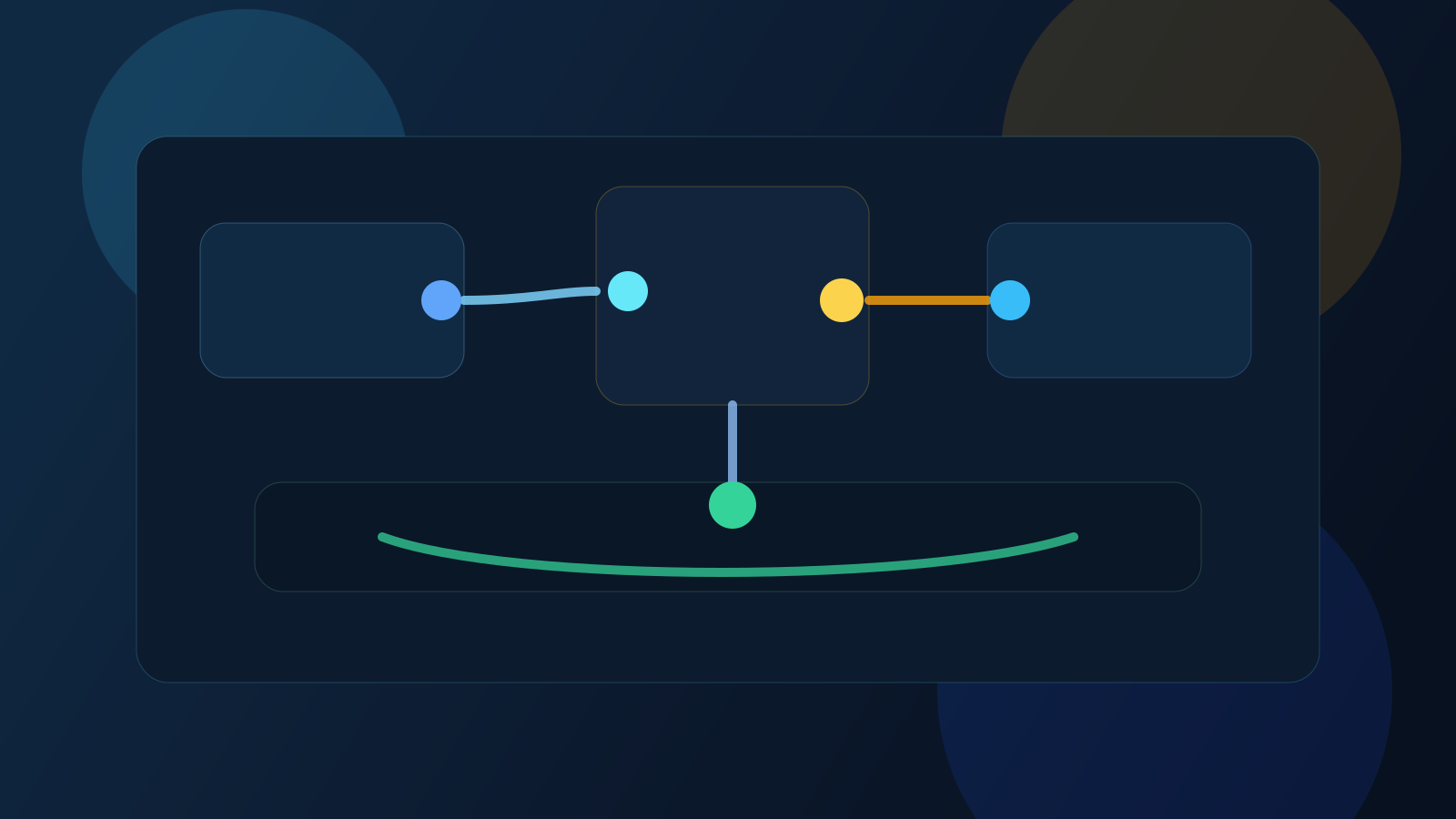
Latency only becomes a real infrastructure advantage when the broker can measure it, explain it, and respond to it. Otherwise it is just another marketing adjective.
Direct answer
Low-latency MetaTrader infrastructure for brokers is not just about putting a VPS closer to a server. It is about shortening and observing the full execution path: where the order originates, how it crosses the network, how the server validates it, whether the account connection is healthy, how much unnecessary workload sits in the environment, and whether support teams can tell the difference between latency, connection failure, and execution rejection.
CheckConnect, PingHost, and PingHostMany, plus a disciplined environment that keeps unnecessary symbols, charts, and brittle automation out of the way. VPS placement helps, but only as one part of a monitored execution path.Why low latency is not one number
The phrase low latency gets used as if it explains everything. In practice, a broker-side MetaTrader stack has several layers that can slow down, fail, or distort execution quality:
- application placement — where your app, gateway, or orchestration layer runs
- network distance — the path from the app or terminal environment to the trade server
- server validation — price checks, funds checks, and account-state checks before an order is processed
- execution mode and market conditions — what happens after the order reaches the server
- environment overhead — unnecessary symbols, wasteful indicators, logs, and resource contention
- monitoring quality — whether operators can see path health before traders open tickets
That is why a broker can have a “fast” VPS and still have a weak infrastructure story. If the connection path is blind, the environment is bloated, or the support team cannot explain what failed, the system is still operationally fragile.
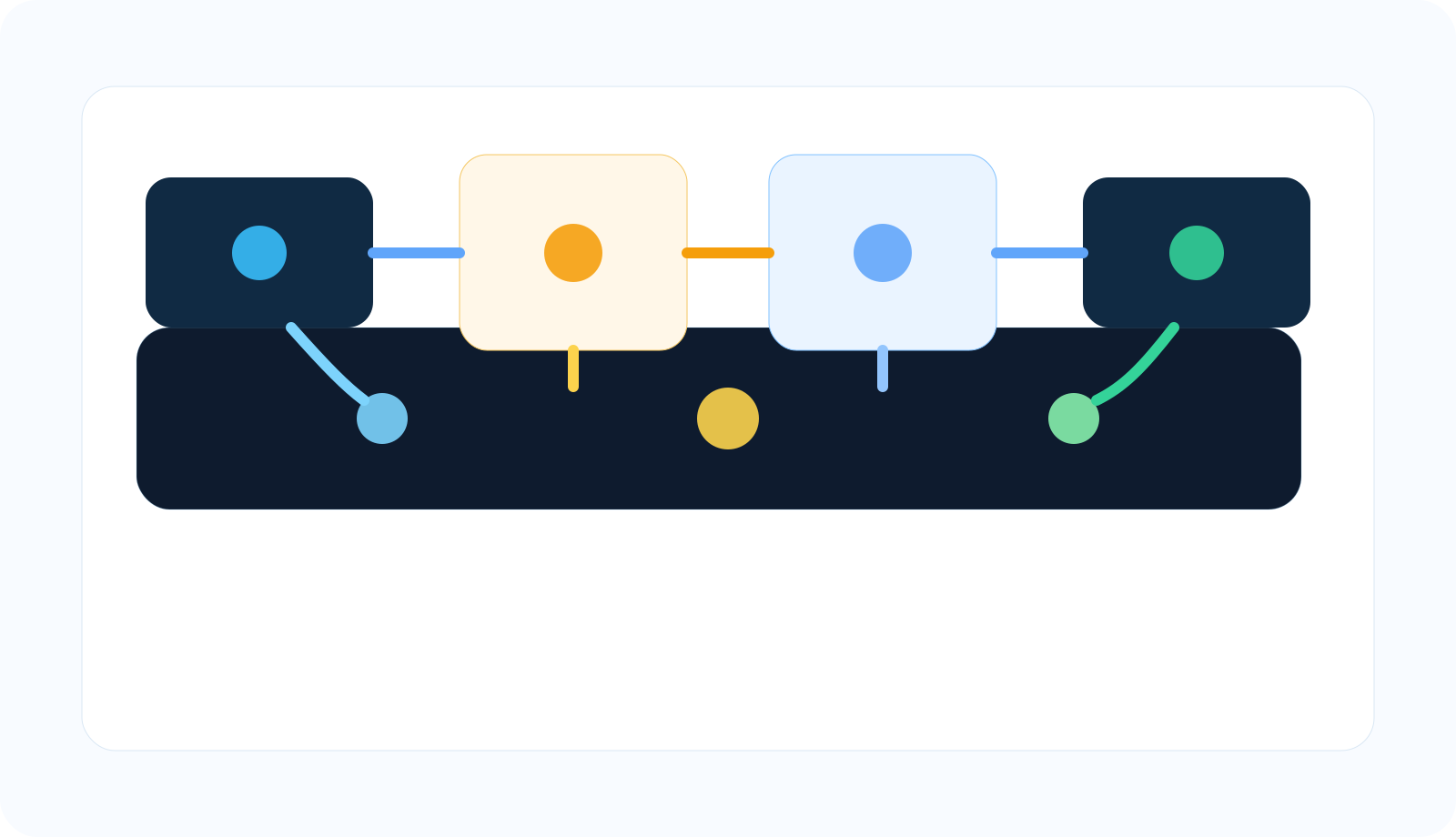
Execution quality is shaped by a path, not a slogan. The useful question is where the path can degrade and how your team measures it.
What the official MetaTrader docs actually show
The official MetaTrader hosting and trading docs are more helpful here than generic low-latency blog posts because they describe concrete operational behavior.
Virtual hosting is about always-on operation and shorter distance
The official MetaTrader 4 virtual-hosting help describes the service as round-the-clock operation for the client terminal. It also states that, unlike an ordinary VDS or VPS, the platform can select the server closest to the broker to minimize network latency when sending orders from the terminal to the trade server.
The MT4 server-registration help goes further: it says the wizard shows how ping will decrease compared to the current connection and that lower network latency between the platform and the broker's server provides better conditions for execution, including reduced slippage and lower probability of re-quotes.
That is useful evidence because it grounds the latency discussion in an official MetaTrader explanation rather than in third-party hype.
Monitoring matters as much as placement
The official MT4 “Working with Terminal” help shows that operators can monitor more than a server location. The page documents ping in milliseconds, virtual-server status, synchronization date, CPU usage, memory usage, hard-disk usage, and terminal or Expert journals.
That is a strong reminder that a hosting decision is not complete unless the broker can actually observe the environment after it is deployed.
Environment tuning changes the path too
The official MT5 migration help gives concrete guidance that is easy to miss in architecture conversations. It recommends removing unnecessary symbols from Market Watch to reduce tick traffic. It notes that the virtual platform automatically downloads history from the trade server but no more than 500,000 bars are available on a chart. It also states that DLL calls are forbidden on the virtual platform and that scripts are not transferred during migration.
Those details matter because they show that low-latency infrastructure is partly a distance problem and partly a workload-discipline problem.
The order path still includes server-side checks
The official MT5 trading help describes a general scheme in which an order is sent to a broker, checked on the server for correctness, and then can be executed, canceled, or rejected. It also notes that when operations are sent to an exchange or liquidity provider they can include an external-system ID.
That means latency is not the only determinant of the outcome. Faster placement helps the path, but execution still depends on what the server and market do next.
| Official docs signal | What it means for brokers | Infrastructure takeaway |
|---|---|---|
| Closest-server hosting guidance | Distance to the broker server changes latency | Placement matters, but must be measured |
| Ping and resource monitoring | Teams can observe path health after deployment | Monitoring is part of the infrastructure design, not an afterthought |
| Tick-traffic and chart-history guidance | Environment weight affects runtime quality | Remove unnecessary workload before chasing new hardware |
| Server-side validation and execution outcomes | Orders can still be checked, rejected, or delayed after placement | Low latency improves one segment of the path, not every segment |
Where the first-party API docs fit
The first-party MetaTraderAPI docs do not turn latency into a solved problem, but they do make the path more observable.
Connection-state visibility
The verified connection docs expose /CheckConnect. That matters because a broker should not confuse a dead or degraded connection with a trader-side complaint about execution quality. Connection-state checks belong in dashboards, alerts, and support workflows.
Service-level latency checks
The verified service docs expose /Ping, /PingHost, and /PingHostMany. The page explicitly describes PingHost and PingHostMany as estimating time to connect to a specified server and port in milliseconds. That gives broker teams a straightforward way to baseline or compare candidate hosts instead of relying on hand-wavy “near LD4” claims.
The same service docs also expose /Search, /LoadSrv, and /LoadServersIni, which are useful when teams need broker-server discovery and infrastructure hygiene around server definitions.
Execution requests still need governance
The verified trading docs expose /OrderSend with fields such as slippage and placedType. That is useful for broker infrastructure because it reminds teams that the app layer can attribute request origin and set request parameters explicitly, but should still keep those actions behind governed logic rather than generic admin buttons.
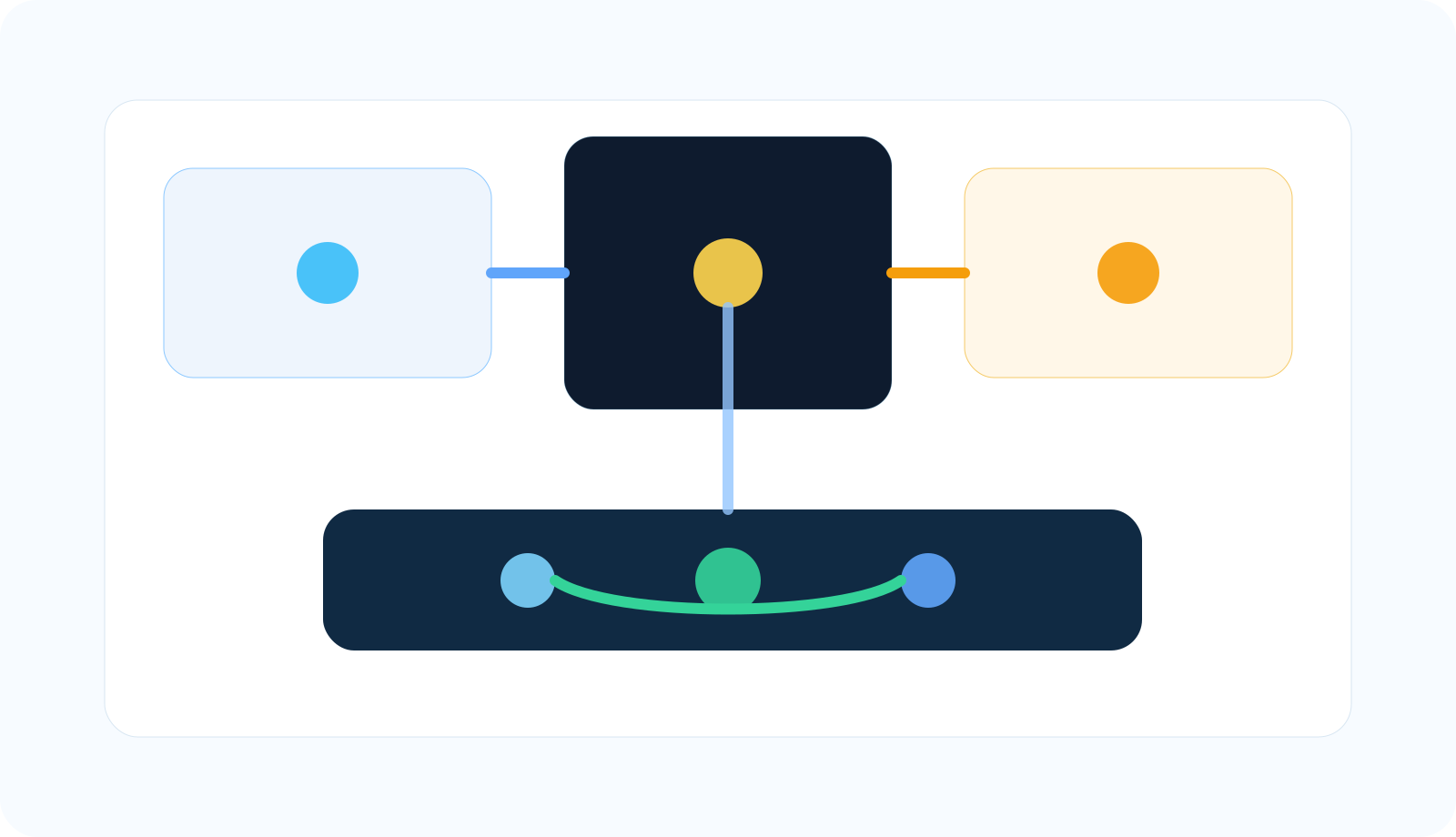
The real value of the API layer here is observability: connection state, host checks, request context, and cleaner operational triage.
Where VPS helps and where it does not
Where VPS or hosted placement helps
- reducing network distance between the runtime environment and the broker server
- keeping automation online when a local PC or office machine is unreliable
- making environment behavior more repeatable than a desktop setup that changes constantly
- centralizing monitoring, migration, and support around a controlled runtime
Where VPS does not solve the problem
- bad symbol settings or account configuration
- execution modes and liquidity conditions outside the app layer
- application logic that retries or places orders incorrectly
- poor monitoring and slow incident response
- resource-heavy environments full of unnecessary charts, symbols, or fragile automation
That distinction is what keeps this topic honest. A VPS can help the path materially. It does not replace broker-quality execution policy, market access, or disciplined operations.
Reference architecture for broker latency monitoring
A practical low-latency MetaTrader infrastructure usually has these layers:
- Placement layer: the VPS, virtual platform, or hosted runtime chosen for proximity and reliability
- Broker application layer: routing logic, retries, permissions, audit trails, and orchestration
- Service and connection checks: Ping, PingHost, PingHostMany, CheckConnect, server discovery, and alerting
- Execution boundary: the actual order path and server-side validation path
- Operations layer: logs, journals, resource monitoring, incident handling, and support runbooks
The key is to avoid treating any one layer as the whole answer. Placement without measurement is guesswork. Measurement without operational response is noise. And execution requests without governance create a new class of risk.
This is also where the broader broker account-management article and the newer CRM integration guide fit. They describe how onboarding, support, and workflow systems should react to the signals this infrastructure produces. If your perspective is the strategy side rather than the broker side, the relevant companion is the scalping-bot guide.
For the trader-facing hosting angle, the closest companion piece is mobile MetaTrader EA hosting. If the simpler question is whether a trader should keep MetaTrader automation on a local desktop or move it into hosted runtime, the comparison on Forex VPS vs home PC for MetaTrader automation is the right handoff. For the technical map of the docs tree, go to the MetaTrader API documentation guide.
Implementation sequence
- Map the path before you optimize it. Write down where the order starts, what host it runs on, which trade server it reaches, and where health is measured today.
- Measure baseline latency. Use host-level checks like
PingHostorPingHostManyto compare candidates instead of choosing by marketing geography alone. - Move the environment closer only after the baseline exists. Placement changes are most useful when you can compare before and after.
- Trim the environment. Remove unnecessary symbols, charts, and wasteful runtime work so the environment does not create its own delay.
- Instrument connection state and resource health. Add
CheckConnect, ping checks, and operator-visible logs or journal review paths. - Separate execution requests from support tools. The app layer should still govern who can place or retry requests and under what policy.
- Run failure drills. Test stale connections, degraded ping paths, overloaded environments, and rejected orders so the team can tell those failure modes apart.
Common mistakes
Reducing the whole topic to “get a VPS”
That is the most common shortcut. VPS placement helps, but only as one part of the path.
Ignoring environment weight
Official MetaTrader migration guidance makes it clear that symbol lists, history depth, and unnecessary runtime work matter. A nearby host can still behave badly if the environment is noisy.
Confusing latency with execution quality
Low latency can improve conditions for execution. It does not guarantee fills, eliminate market constraints, or override broker-side validation logic.
Running blind after deployment
If teams do not review ping, synchronization status, resource consumption, and journals, the infrastructure may degrade long before anyone notices.
Mixing business workflow problems with path-health problems
Support queues and CRM workflows should consume path signals, not hide them. Otherwise every complaint looks the same and the real cause stays invisible.
Conclusion
Low-latency MetaTrader infrastructure for brokers is really a path-design problem. The hosting location matters. The network path matters. The server checks matter. The environment load matters. And the monitoring layer matters just as much as all of them.
The official MetaTrader hosting docs show why distance and monitoring both matter. The first-party service and connection docs add a practical way to measure and observe that path inside a broker application. When those layers work together, brokers can move from vague “fast execution” claims to something much more useful: an infrastructure story they can explain, measure, and improve.
References and Source Notes
- MetaTraderAPI.dev Authentication - First-party auth model for Single Account and Pro plans
- MetaTraderAPI.dev MT4 Connection Docs - Documents CheckConnect for connection-state monitoring
- MetaTraderAPI.dev MT4 Service Docs - Documents Ping, PingHost, PingHostMany, Search, LoadSrv, and LoadServersIni
- MetaTraderAPI.dev MT4 Trading Docs - Documents OrderSend with slippage and placedType fields
- MetaTrader 4 Help: Virtual Hosting - Official overview of 24/7 hosting and minimum-latency server selection
- MetaTrader 4 Help: Registering Server - Official guidance on nearest-server selection, lower ping, reduced slippage, and lower probability of re-quotes
- MetaTrader 4 Help: Working with Terminal - Official monitoring view with ping, status, synchronization date, resources, and journals
- MetaTrader 5 Help: Migration - Official guidance on symbol lists, history load, DLL restrictions, scripts, and monitoring logs
- MetaTrader 5 Help: Basic Principles - Official description of order flow, server validation, execution, rejection, and external-system IDs
- How Brokers Automate Account Management with MetaTrader API - Related broker-operations article on the same domain
- MetaTrader API CRM Integration - Related article on workflow and support-system integration
- How to Build a Reliable Forex/CFD Scalping Bot Using api2trade.com - Related latency-sensitive product use case
- Mobile MetaTrader EA Hosting - Related trader-facing hosting guide
- Forex VPS vs Home PC for MetaTrader Automation - Related comparison for trader-side runtime placement and failure modes
- MetaTrader API Documentation Guide - Docs map for implementation teams
FAQs
- Does moving MetaTrader closer to the broker automatically guarantee better execution?
No. Lower latency can improve conditions for execution, but it does not guarantee fills, override server-side checks, or solve poor liquidity and policy problems.
- What are the first checks a broker should instrument in a low-latency stack?
A good starting set is connection-state monitoring with CheckConnect plus host-level latency checks with PingHost or PingHostMany, followed by resource and journal review for the runtime environment.
- Why can a nearby VPS still perform poorly?
Because distance is only one part of the path. A nearby environment can still be overloaded, misconfigured, disconnected, or attached to weak workflow logic and poor monitoring.
- What does the official MetaTrader hosting guidance say about environment tuning?
The official guidance recommends removing unnecessary symbols to reduce tick traffic, managing chart history carefully, and monitoring logs and runtime resources. That is a strong sign that environment discipline matters alongside network placement.
- What is the biggest mistake in broker latency projects?
The biggest mistake is treating latency as a slogan instead of a measured path. If the team cannot say where latency is measured, what changed, and how operators respond when the path degrades, the architecture is still incomplete.