Broker integration gets messy when one team treats MetaTrader like the whole platform, another treats the CRM like the whole workflow, and a third treats payment events like the final authority. Good architecture fixes that by defining ownership before it builds automations.
Direct answer
Forex broker API integration works when the broker treats CRM, payments, onboarding, support, and trading-account workflows as one coordinated system instead of forcing one tool to do every job. The documented MetaTrader side gives you account identity, current account state, connection checks, service diagnostics, and a governed trading boundary. Your CRM and payment systems sit around that boundary, not inside it. The application layer is what keeps those systems synchronized, attributed, and safe.
That is the difference between a reliable broker stack and a tangled one. Weak integration projects try to mirror everything everywhere. Strong ones define which system owns which fact, then synchronize only the facts each team needs to operate.
If you need the first-party docs tree before the architecture, start with the MetaTrader API documentation guide. If you want the wider account, history, and metrics model that sits beneath broker dashboards and review tools, the technical companion is building a MetaTrader performance analytics pipeline.
Why broker API integration is a systems-design problem, not just an endpoint problem
Broker integrations usually fail in one of two ways.
- Everything gets pushed into the CRM. Suddenly the CRM is expected to understand account registration, connection state, health checks, and sometimes even execution decisions.
- Everything gets pushed into the trading side. The account workflow ends up carrying payment status, KYC approvals, customer-service state, and sales process logic it was never meant to own.
Both patterns create trust problems. Sales sees stale onboarding state. Support cannot tell whether a client issue is operational or financial. Finance cannot tell whether payment activation actually resulted in an account step. And engineers end up adding business rules in whichever system was easiest to patch first.
A better design starts with one question: which system owns the truth for this fact?
- relationship and pipeline ownership belongs in the CRM
- payment and billing ownership belongs in the finance or payment stack
- account registration, account state, connection health, and governed trade-side workflows belong around the MetaTrader API boundary
- cross-system decisions belong in the broker application layer
That is why this article is broader than the existing CRM page or infrastructure page on this domain. It is the broker-facing hub for how those pieces fit together as one operating model.
What the documented MetaTrader side actually gives you
The first-party docs are useful here because they show the real integration boundary clearly instead of leaving it to guesswork.
Authentication and service identity
The live authentication docs document two access models. Single Account plans use x-api-key plus account UUID. Pro plans use Basic Auth with a dedicated base URL. That matters because the broker app should integrate with a governed service identity, not with ad hoc human credentials sprinkled through automation.
Account registration and account state
The live account docs document workflow surfaces such as RegisterAccount, GetAccounts, AccountSummary, and AccountDetails. That means the MetaTrader-facing side can register accounts, enumerate known accounts, and provide current account context before any CRM or support view tries to display it.
This is where a broker integration usually begins in real life. A customer is approved, a payment or subscription event is accepted, an account is registered, and the resulting account identity is mapped back into the business workflow.
Connection and service diagnostics
The connection and service docs make the operational boundary more concrete. CheckConnect exists for connection-state checks, while the service family includes workflows such as Ping, PingHost, PingHostMany, Search, LoadSrv, and LoadServersIni. These are not decorative details. They are the reason a broker can build support and operations tooling that distinguishes a stale path from a normal quiet account.
Trading belongs in a governed boundary
The live trading docs document OrderSend and the request model around it. The official MT5 basic principles help explains the order lifecycle too: an order is sent to the broker, checked on the server, and can then be executed, canceled, or rejected. It also notes that operations sent to an exchange or liquidity provider can carry an external-system ID.
That is exactly why generic CRM workflow rules should not become your execution engine. Trading requests belong in a governed application boundary where permissions, auditability, and operational policy are explicit.
| Workflow family | What it gives the broker app | Why the rest of the stack cares |
|---|---|---|
| Authentication | Service identity and account-scoped access | Keeps automations tied to known accounts and owned credentials |
| Account | Registration, listing, summary, and detail context | Supports onboarding, support views, and customer-account mapping |
| Connection + service | Connection checks, host tests, and service diagnostics | Lets support and ops workflows react to real health signals |
| Trading | Governed order-side boundary | Reminds the broker to keep execution controls out of generic CRM automations |
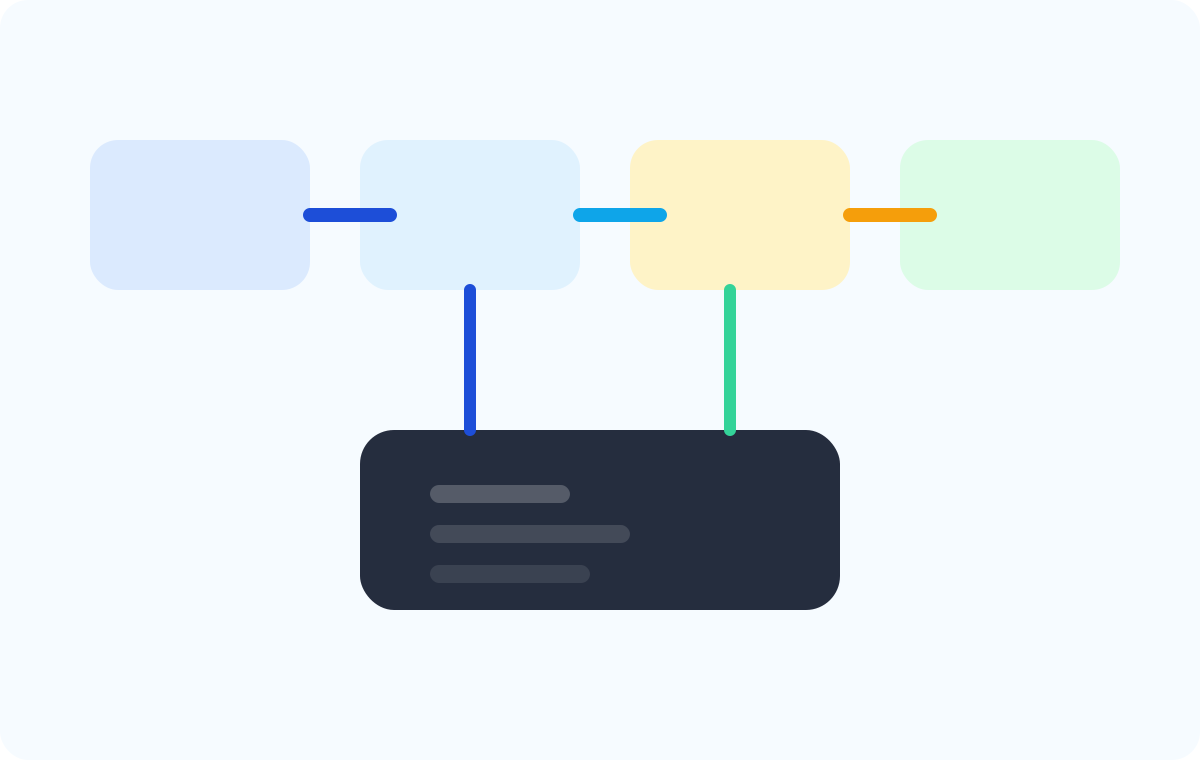
The MetaTrader side should stay the account and execution boundary. The rest of the business stack should coordinate around it, not collapse into it.
How CRM and payment systems fit around the MetaTrader boundary
CRM owns relationships and workflow state
The official Salesforce guide is useful because it frames CRM integration by workload shape, not by hype. Salesforce recommends different object-data APIs depending on scale: sObject resources for individual-record CRUD, Composite resources for multi-operation requests, Query for retrieval, and Bulk API for large data volumes. That maps well to broker operations because broker workflows are not one-size-fits-all.
- single contact or company updates fit the per-record model
- onboarding sequences often need composite-style updates across contact, deal, and case records
- support or reporting screens may lean on query patterns
- larger reconciliations or migrations may need bulk workflows
HubSpot's official CRM docs describe the same design idea in a different shape: objects, records, properties, associations, schemas, search, and pipelines. The docs also make clear that broker-relevant object families can include contacts, companies, deals, tickets, invoices, payments, and subscriptions. That is useful because it reinforces the right separation: the CRM can hold customer, deal, support, billing-reference, and pipeline context without pretending to be the trading system.
Payment and billing systems own financial state
The payment or finance layer is where brokers often create hidden confusion. Payment success, subscription state, invoice issuance, and financial reconciliation are operationally important, but they are adjacent systems. They should feed the broker application layer and the CRM with the right status changes and references. They should not be described as MetaTrader-native capabilities unless the documentation actually says so.
A clean pattern usually looks like this:
- a payment or subscription event is accepted in the finance stack
- the broker application validates whether the next onboarding step is now allowed
- the app triggers or permits account registration on the MetaTrader side
- the account UUID and resulting status are written back to the CRM
- support and onboarding teams see one coherent workflow state, even though several systems participated
Event-driven integrations are useful after field ownership is clear
The official Salesforce Pub/Sub API docs matter here because they show a clean event-driven option: publishing and subscribing to platform events and change data capture events. That is powerful for brokers, but only after field ownership is explicit. Event-driven sync does not fix a weak model. It amplifies a good one.
If the team still has not agreed on which system owns payment state, account activation state, or support resolution state, real-time events only make the confusion faster.
Reference architecture for forex broker API integration
A practical broker stack usually has five layers.
- CRM layer: contacts, companies, deals, tickets, tasks, pipeline state, customer ownership
- Payment and finance layer: invoices, payment confirmation, subscriptions, reconciliation, billing events
- Broker application layer: permissions, orchestration, retries, mapping rules, audit trails, and field ownership logic
- MetaTrader API layer: authentication, account workflows, connection diagnostics, service checks, and governed trading actions
- Operator and reporting layer: dashboards, support tools, exception queues, and escalation workflows
The broker application layer is the most important part because it decides what each event means. A successful payment might unlock one onboarding step but not another. An approved KYC check might allow registration but still require manual review before leverage or program type changes. A connection failure might open a support ticket but should not silently rewrite customer status in the CRM without context.
This is the real architecture rule: business decisions belong in the application layer, not in whatever adjacent system happened to emit the most recent event.
If you want the narrower deep dives that sit beneath this hub:
- read how brokers automate account management with MetaTrader API for the day-to-day account-ops layer
- read MetaTrader API CRM integration for the record-model and field-ownership layer
- read low-latency MetaTrader infrastructure for brokers for execution-path and observability concerns
- read prop-firm rule enforcement around MetaTrader accounts if the broker also runs evaluation or funded-account workflows
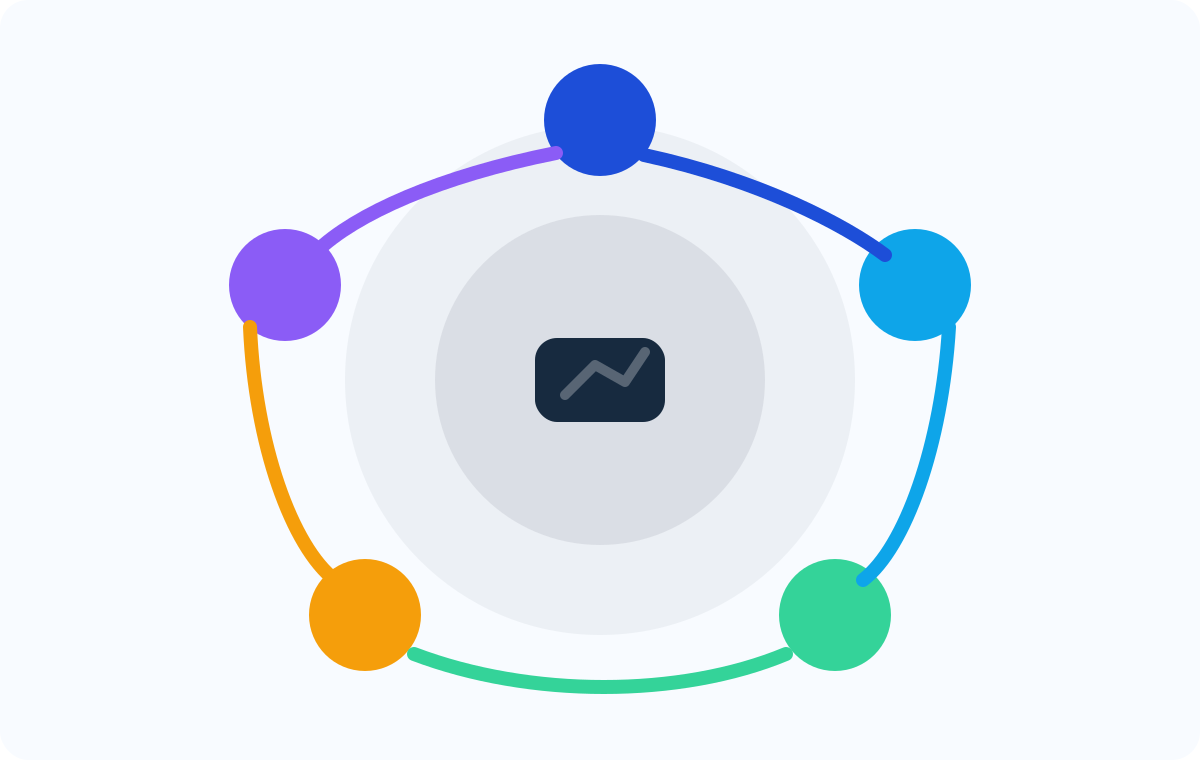
A strong broker integration moves events through a governed application layer instead of letting each adjacent system act like the whole platform.
Implementation sequence
- Map the systems of record. Decide which platform owns contact identity, deal state, payment state, KYC state, account UUID, account health, and execution authority.
- Create a durable identity model. Tie CRM records, internal customer IDs, payment references, and MetaTrader account IDs together explicitly.
- Automate the account-creation path carefully. Registration should happen through the application layer after the right prerequisite states are satisfied, not from a generic CRM button with no policy context.
- Write the right operational facts back to the CRM. Account UUID, account type, onboarding state, high-level health, and support context are useful. Secrets and raw execution logic are not.
- Keep payment events adjacent to the account flow. Payment success should inform the broker workflow, but not silently replace account-state validation or support checks.
- Add connection and infrastructure observability. Support and onboarding teams need to know whether a delay is commercial, operational, or infrastructural.
- Introduce real-time or event-driven sync only after the model is stable. This is where platform events or change-data style sync becomes useful instead of dangerous.
If your team later needs to turn these workflows into broader product surfaces, the product-architecture companion is Build a Forex SaaS with MetaTrader API.
Common mistakes
Using the CRM as the integration brain
The CRM is valuable for relationships and workflow visibility. It should not quietly become the place where trading or account policy is decided with no governed application layer in between.
Describing payment systems as MetaTrader-native features
Payment activation, invoices, and subscriptions matter operationally, but they are adjacent workflow systems. Mixing them into MetaTrader claims without clear boundaries creates misleading product language and fragile implementations.
Skipping field ownership design
If support, finance, onboarding, and engineering teams cannot tell which system owns a status, duplicates and broken automations show up fast.
Over-syncing raw data
Not every raw trading artifact belongs in the CRM. Most teams need identifiers, snapshots, health state, and references back to the underlying system, not a second trading database inside the business stack.
Letting events make business decisions by themselves
Real-time events are useful, but they should feed application logic. They should not bypass it.
Conclusion
Strong forex broker API integrations are not about collapsing CRM, payments, and MetaTrader into one tool. They are about connecting them cleanly.
The documented MetaTrader side gives brokers a strong account and execution boundary. Salesforce and HubSpot provide relationship and workflow context. Payment and finance systems provide commercial state. The broker application layer is what turns those separate truths into one operating model the business can actually trust.
When those roles stay clear, onboarding gets smoother, support gets better context, payment events stop creating confusion, and the execution boundary stays governed instead of being smuggled into the wrong system.
References and Source Notes
- MetaTraderAPI.dev Authentication - Documents Single Account auth with x-api-key plus account UUID and Pro auth with Basic Auth plus a dedicated base URL
- MetaTraderAPI.dev MT4 Account Docs - Documents RegisterAccount, GetAccounts, AccountSummary, and AccountDetails
- MetaTraderAPI.dev MT4 Connection Docs - Documents CheckConnect for account connection checks
- MetaTraderAPI.dev MT4 Service Docs - Documents Ping, PingHost, PingHostMany, Search, LoadSrv, and LoadServersIni
- MetaTraderAPI.dev MT4 Trading Docs - Documents OrderSend and the governed trading request boundary
- MetaTrader 5 Basic Principles - Official description of orders, deals, positions, server-side checks, execution, rejection, and external-system IDs
- Salesforce Developers: Accessing Object Data with Salesforce Platform APIs - Official guide to sObject, Query, Composite, and Bulk API patterns
- Salesforce Developers: Pub/Sub API - Official guide to platform events, change data capture events, and event-driven integration apps
- HubSpot Docs: Understanding the CRM APIs - Official overview of objects, records, properties, associations, schemas, search, pipelines, and object families including tickets, invoices, payments, and subscriptions
- How Brokers Automate Account Management with MetaTrader API - Related broker-account-ops article on the same domain
- MetaTrader API CRM Integration - Related CRM-specific implementation article
- Low-Latency MetaTrader Infrastructure for Brokers - Related infrastructure and observability article
- How to Build Prop Firm Rule Enforcement Around MetaTrader Accounts - Related broker/prop workflow article
- Building a MetaTrader Performance Analytics Pipeline - Authority-layer article for the account, history, metrics, and verification model beneath broker dashboards and review products
- MetaTrader API Documentation Guide - Docs map for implementation teams
FAQs
- What is the core idea behind forex broker API integration?
The core idea is to keep MetaTrader account and execution workflows, CRM records, payment events, and operational decisions connected through one governed application layer instead of forcing one system to own everything.
- Should a CRM place trades directly in a broker workflow?
Usually no. The CRM should provide relationship and workflow context, while trading requests stay behind a governed application and MetaTrader-facing boundary with permissions and auditability.
- Where should payment status live in a broker stack?
Payment status should live in the payment or finance layer and be projected into the broker workflow where needed. It can unlock or inform account actions, but it should not be confused with MetaTrader-native account truth.
- What MetaTrader workflows matter most for broker integrations?
Authentication, account registration and summaries, connection checks, service diagnostics, and a governed trading boundary are the most important workflow families because they define the operational truth the rest of the broker stack must coordinate around.
- What is the biggest mistake in broker integration projects?
The biggest mistake is skipping field and decision ownership. Once teams can no longer say which system owns the fact and which layer made the decision, the integration becomes difficult to trust and difficult to scale.