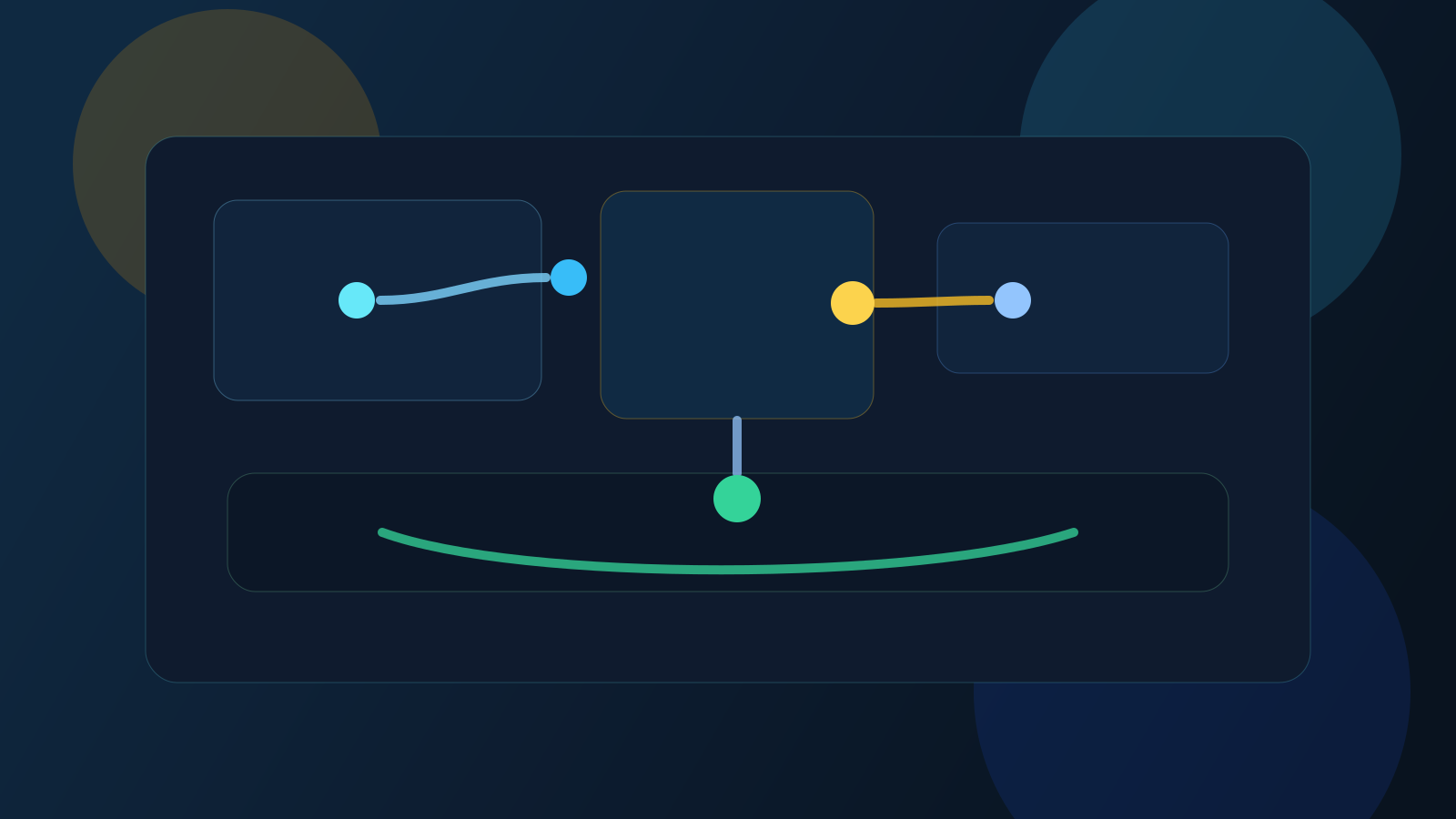
A prop firm's rule engine is only as trustworthy as the evidence and timing model behind it. If the platform cannot explain which state, which window, and which policy created a pass, fail, or review decision, the system may look automated while still being operationally fragile.
Direct answer
Prop-firm rule enforcement around MetaTrader accounts is an application-layer policy system built on top of verified account state, time-windowed history, stats, and audit evidence. The API boundary helps your platform observe and organize those inputs. Your own rule engine still decides when a trader has breached a hard limit, when a case needs review, and when an account can move from one stage to the next.
This is the big difference between serious prop infrastructure and thin marketing content. A connector does not become a rule engine just because it exposes account workflows. The prop firm's product and risk layer still has to define the rules, windows, exceptions, and operator actions that make the business defensible.
Why rule enforcement is not one endpoint
Prop rules are rarely a single yes-or-no check. They usually combine:
- current account state, such as balance, equity, and margin context
- time-windowed history, such as the current trading day or evaluation phase
- derived metrics, such as drawdown or trade-efficiency views
- operational evidence, such as logs, connection state, and review notes
- business states, such as challenge, verification, funded, paused, failed, and review
That mix is why prop-firm enforcement belongs in your own application layer. The connector helps you observe the account and its activity. Your system decides what that means inside the firm's published rules.
This article fits directly beside MT5 API for prop trading firms, which explains the wider challenge-account lifecycle. This piece goes one layer deeper into the actual rule model.
What public prop rules actually look like
Public prop-firm rules are useful because they show what real operators are trying to enforce, even when the exact thresholds differ by firm. A public Quant Funded FAQ checked on April 16, 2026 describes several rule families that are common across the category:
- max daily loss
- max overall loss
- profit targets
- minimum trading-day requirements
- close positions before moving stages
- restrictions on certain EA or execution styles
- consistency-style rules around profit concentration
That public FAQ is not an industry standard and it can change over time, but it is a good example of what a real prop-firm ruleset looks like in practice: not just return targets, but risk limits, timing rules, behavior restrictions, and review-triggered conditions.
| Rule family | What the firm is trying to control | Typical data needed | Enforcement style |
|---|---|---|---|
| Daily loss | Intraday risk and floating-loss pressure | Current equity or balance plus current-day history window | Usually automatic hard breach |
| Overall loss | Total capital preservation | Current account state against starting or allowed threshold | Usually automatic hard breach |
| Profit target | Stage completion | Time-windowed closed performance and account state | Usually automatic eligibility check |
| Trading-day minimums | Avoid one-day pass behavior | Distinct active trading days in the evaluation window | Usually automatic eligibility check |
| Consistency or concentration | Profit distribution and behavior quality | Order history plus derived stats or custom calculations | Often review-triggered or hybrid |
| Prohibited strategy behavior | Abusive execution styles, disallowed robots, or unfair demo exploitation | History patterns, logs, and review evidence | Usually review-triggered with operator confirmation |
| Stage transition closure | No open exposure during handoff | Current state plus transition policy | Automatic gate with possible operator review |
The useful lesson is not to clone another firm's thresholds. The useful lesson is to recognize that prop rules combine math, timing, and policy. Your system has to support all three.
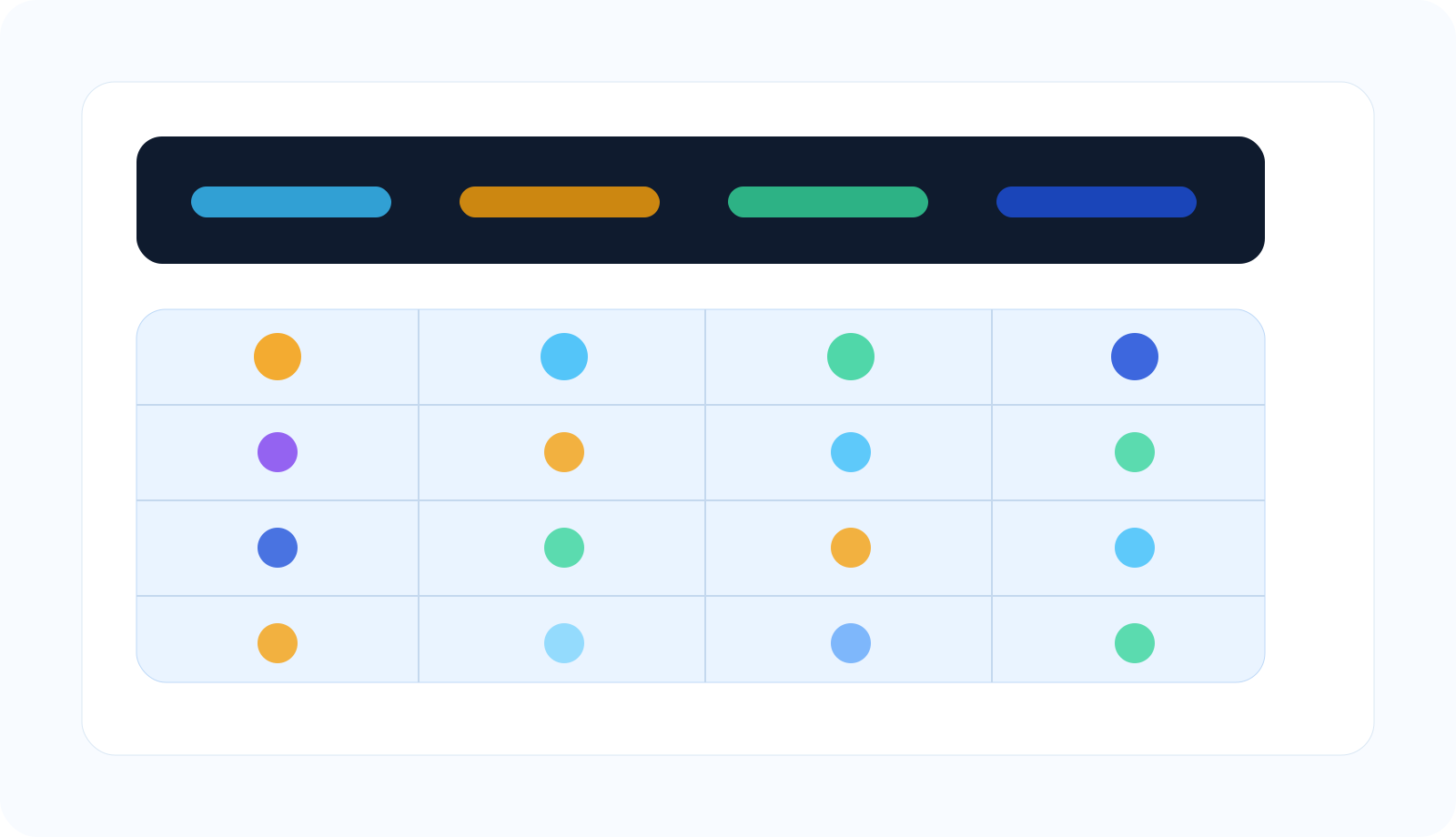
A real prop-firm rules engine combines thresholds, timing windows, and review logic instead of treating every rule as one simple score.
Which docs-backed workflow families matter most
The first-party docs are most useful here when you map them to rule-enforcement needs instead of reading them as a flat endpoint list.
Account state
The verified account docs in this workspace show a model that includes account registration, listing, summaries, and details. For rule enforcement, the key idea is that the application can observe current account state through an account summary workflow instead of relying only on manual terminal checks.
That matters for rules like max overall loss, funding-stage eligibility, and operational triage. A risk team needs to know the current state before it interprets whether a rule has been breached.
Connection health
The documented /CheckConnect workflow on the connection docs matters because firms should not confuse a connection problem with a trader breach. If the enforcement system is blind to connection state, it eventually generates bad reviews, bad support responses, or both.
Time-windowed order history
The verified /OrderHistory workflow is one of the most important pieces in a prop stack because many rules are based on explicit windows: current day, current stage, rolling review period, or payout period. A rule engine needs a clean way to anchor those windows to actual account history.
Derived stats
The verified TradeStats examples in this workspace include fields such as profitFactor, expectancy, averageTradeLength, balanceDrawdownRaw, realizedPL, and unrealizedPL. Those do not automatically equal your firm's rule logic, but they are useful building blocks for dashboards, review queues, and anomaly detection.
Reports and logs as the audit layer
The official MT5 platform help fills in the evidence side. The history help documents orders, deals, positions, filtering, and report export. The official trading report defines metrics such as Profit Factor, Recovery Factor, Max. Drawdown, Max. Deposit Load, MFE, and MAE. The advanced history report documents summary values such as Balance, Equity, Margin, Free Margin, Closed Trade P/L, and Floating P/L. The platform logs page confirms that journals remain part of the operational evidence layer.
That is the right mental model: the app layer helps you operationalize enforcement, while the platform reports and logs remain part of the audit trail.
Which rules should be automatic and which should be review flags
One of the biggest design mistakes in prop systems is treating every rule as if it should trigger the same kind of action. In practice, good enforcement separates hard breaches from review signals.
Good candidates for automatic hard breaches
- max daily loss crossing a published threshold
- max overall loss crossing a published threshold
- stage-transition checks failing when a hard prerequisite is missing
- minimum required days not yet met, if the rule is purely mechanical
These are usually threshold-driven and easier to explain.
Good candidates for review-triggered workflows
- strategy-behavior concerns that require interpretation
- suspicious account correlation across several accounts
- EA-related concerns that require due diligence
- consistency or concentration issues that are partly mathematical and partly policy-driven
- cases where logs or support notes may change the interpretation
These are exactly the kinds of conditions that become dangerous when a firm over-automates too early. If the rule depends on interpretation, the best workflow is usually flag, collect evidence, review, then decide.

The strongest rule engines do not flatten everything into one ban button. They separate hard breaches from review-driven decisions.
How the architecture should fit together
A practical prop-firm enforcement stack usually has these layers:
- Trader-facing product layer: account dashboard, challenge status, notices, phase transitions, support messages
- Rule engine and workflow layer: thresholds, timing windows, state transitions, review queues, operator actions, audit logs
- Evidence collection layer: account summaries, connection checks, order history, trade stats, reports, and logs
- Underlying MetaTrader account infrastructure: the actual account environment and trading records
The clean rule is this: the rule engine owns interpretation, while the evidence layer owns observation. Once those responsibilities blur, enforcement gets harder to explain and harder to trust.
This is also where broker account-management automation overlaps with prop operations. Provisioning, account visibility, support triage, and account state still matter. The prop-specific layer adds challenge rules, transitions, and evaluation logic on top.
If your next question is whether the enforcement model should be MT4-first, MT5-first, or dual-platform, the paired architecture article is MT4 API vs MT5 API. If the next question is how to navigate the docs tree, go to the MetaTrader API documentation guide.
A practical implementation sequence
- Define the public rules first. Your enforcement system is only as clean as the published rules it is trying to encode.
- Define the account states. Challenge, verification, funded, paused, failed, and review should be explicit in your own application.
- Lock the timing model. Daily reset time, stage windows, and review periods should be unambiguous before any automation goes live.
- Map each rule to an evidence source. Decide whether it depends on current state, order history, derived stats, logs, or a combination.
- Separate hard breaches from review rules. Not every rule should trigger the same action automatically.
- Preserve the audit trail. Every important decision should have a visible path back to the data and rule version used to make it.
- Test the workflow on edge cases. Breach after target hit, inconsistent history windows, stale connection state, and manual overrides are where immature rule engines usually fail.
If your prop stack is still earlier in the lifecycle, the broader companion read is MT5 API for prop trading firms. That article covers the challenge-account lifecycle more broadly, while this one focuses on enforcement depth.
Common mistakes
Encoding vague rules into hard automation
If the rule language is ambiguous, hard automation magnifies the ambiguity. Public policy has to be clear before the system becomes strict.
Mixing time windows accidentally
Daily loss, phase performance, payout windows, and lifetime stats are different windows. Mixing them silently creates enforcement errors that are hard to explain later.
Ignoring logs and support evidence
History and stats are essential, but some cases still need journal evidence and operator notes. Enforcement systems that ignore operational evidence become brittle.
Letting the connector become the policy layer
The bridge exposes workflows. It should not quietly become the place where your business rules live in scattered scripts and one-off support actions.
Assuming one firm's rules are the category standard
Public prop programs are useful for learning the shape of enforcement, but thresholds and policy wording differ. Use them as pattern references, not as universal truth.
Conclusion
Building prop-firm rule enforcement around MetaTrader accounts is really about building a trustworthy policy system on top of a trustworthy evidence system.
The official MetaTrader reports and logs provide the raw evidence layer. The documented app-side workflows around account state, connection checks, time-windowed history, and derived stats help you operationalize that evidence inside your own platform. Your rule engine then interprets it according to the firm's published policy.
When those layers stay clean, enforcement becomes easier to explain, easier to review, and much more defensible for both operators and traders.
References and Source Notes
- Quant Funded FAQ - Public prop-firm FAQ checked on April 16, 2026 with examples of loss limits, profit targets, EA restrictions, and consistency-style rules
- MetaTrader 5 Trading Account History - Official MT5 history views for orders, deals, positions, filtering, and report export
- MetaTrader 5 Trading Report - Official MT5 report definitions for Profit Factor, Recovery Factor, Max. Drawdown, Max. Deposit Load, MFE, and MAE
- MetaTrader 5 Advanced History Report - Official advanced report structure with Balance, Equity, Margin, Free Margin, Closed Trade P/L, and Floating P/L
- MetaTrader 5 Platform Logs - Official journal/log reference for operational review and audit
- MetaTraderAPI.dev Authentication - First-party auth model for app-side enforcement workflows
- MetaTraderAPI.dev MT4 Account Docs - Documents RegisterAccount, GetAccounts, AccountSummary, and AccountDetails
- MetaTraderAPI.dev MT4 Connection Docs - Documents CheckConnect for connection-state monitoring
- MetaTraderAPI.dev MT4 Order History - Documents date-scoped OrderHistory access
- MetaTraderAPI.dev MT4 Trade Stats - Documents TradeStats metrics such as profitFactor, expectancy, averageTradeLength, and drawdown values
- MetaTraderAPI.dev MT5 Connection Docs - Confirms MT5-side CheckConnect coverage
- MT5 API for Prop Trading Firms - Related article on broader prop-firm lifecycle architecture
- How Brokers Automate Account Management with MetaTrader API - Related article on account-lifecycle and broker operations workflows
- MetaTrader API Documentation Guide - Docs map for implementation teams
- MT4 API vs MT5 API - Related article on platform-choice framing
FAQs
- Does a MetaTrader API automatically enforce prop-firm rules by itself?
No. The API boundary provides account and history workflows, but the prop firm's own application still has to define the rules, timing windows, thresholds, review queues, and operator actions that turn those workflows into real enforcement.
- Which rules are easiest to automate first?
Max daily loss, max overall loss, simple profit-target eligibility, and minimum trading-day checks are usually the easiest starting points because they are threshold-driven and easier to explain than behavior-based rules.
- Which rule types usually need human review instead of pure automation?
Consistency rules, suspicious behavior patterns, account correlation, certain EA-related concerns, and strategy-style restrictions often need a review workflow because the math alone does not always capture the policy context.
- Why do account summaries, order history, and trade stats all matter for enforcement?
Because strong enforcement needs current account state, a clean time-windowed history, and derived metrics or drawdown context. Relying on only one of those layers usually produces blind spots or rule interpretations that are hard to defend later.
- What is the biggest design mistake in prop-firm rule systems?
The biggest mistake is collapsing policy, evidence collection, and operator action into one blurry automation layer. A cleaner system keeps the evidence layer observable, the rule engine explicit, and the review path auditable.